Marine life
The mangroves of Baja California Sur store more carbon than tropical ones
Small, scarce and surrounded by desert: a study found these mangroves store up to five times more carbon underground than their tropical counterparts.
A tiny ecosystem with an outsized role
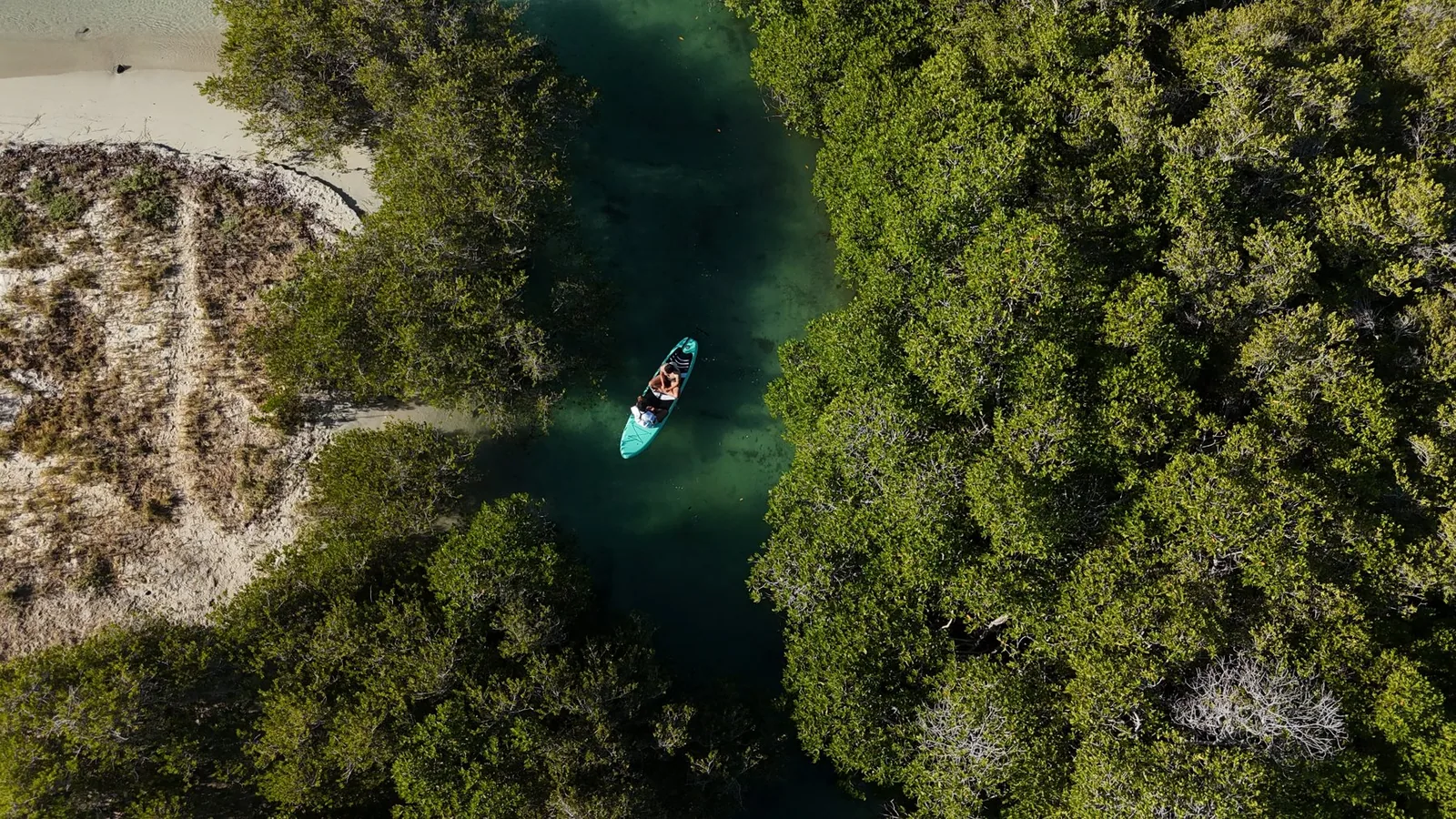
Mangroves cover less than 1% of the land area of northwestern Mexico, according to a 2016 study published in the journal PNAS. Even so, that thin strip between sea and land packs an ecological role — and a carbon-storage capacity — completely out of proportion to its size.
Why the desert makes them different
The same study compared mangroves in two desert lagoons in Baja California Sur — Bahía Magdalena and Balandra — with mangroves in two tropical lagoons on the Mexican Pacific coast. The desert mangroves stored up to five times more carbon underground than their tropical counterparts, built up in a layer of undecomposed roots, or peat, up to four meters deep and as much as 2,000 years old.
The explanation has to do with the terrain: along Baja California’s rocky, desert coastline, mangroves can’t migrate inland to keep up with rising sea level the way mangroves on tropical floodplains do. Instead, they grow on top of their own accumulated root remains, building an ever-thicker layer of peat.
Nearly a third of the region’s carbon
According to the same researchers, these mangroves and halophyte scrublands in Mexico’s arid northwest — with less than 1% of the land area — store close to 28% of the region’s total belowground carbon. No other nearby ecosystem comes close to that concentration.
A resource that is also disappearing
Based on CONABIO figures cited in the same study, Mexico’s mangroves have been shrinking by roughly 3% a year as human activity advances along the coast. According to the researchers, removing a mangrove immediately releases thousands of years of stored carbon back into the atmosphere, while also erasing an ecosystem that can no longer keep sequestering new carbon.
That is why, in Mexico, the Ley General de Vida Silvestre (General Wildlife Law) prohibits removing, filling, transplanting or pruning mangrove, or carrying out any work that affects its hydrological flow; the law only exempts work aimed at protecting, restoring or researching these areas.
Seeing them from a kayak
Paddling a mangrove channel by kayak — as happens on some of Con Gorra’s trips in Baja California Sur — is a quiet way to be close to this ecosystem without disturbing it. Beneath the calm water and tangled roots lies a thousands-of-years-old carbon store that, at a glance, is completely invisible.
References to keep exploring
- PNAS · Ezcurra et al. (2016) · Coastal landforms and accumulation of mangrove peat increase carbon sequestration and storage
- Ley General de Vida Silvestre (México) · Artículo 60 TER · Protección legal de los manglares
Sources accessed on November 8, 2026. Editorial text by Con Gorra Expeditions.