Marine life
What are mobulas, and why do they gather in schools at La Ventana?
Every year, thousands of mobula rays turn La Ventana bay into one of the best-documented aggregation and breeding sites for this vulnerable fish.
A small fish with wings for a name
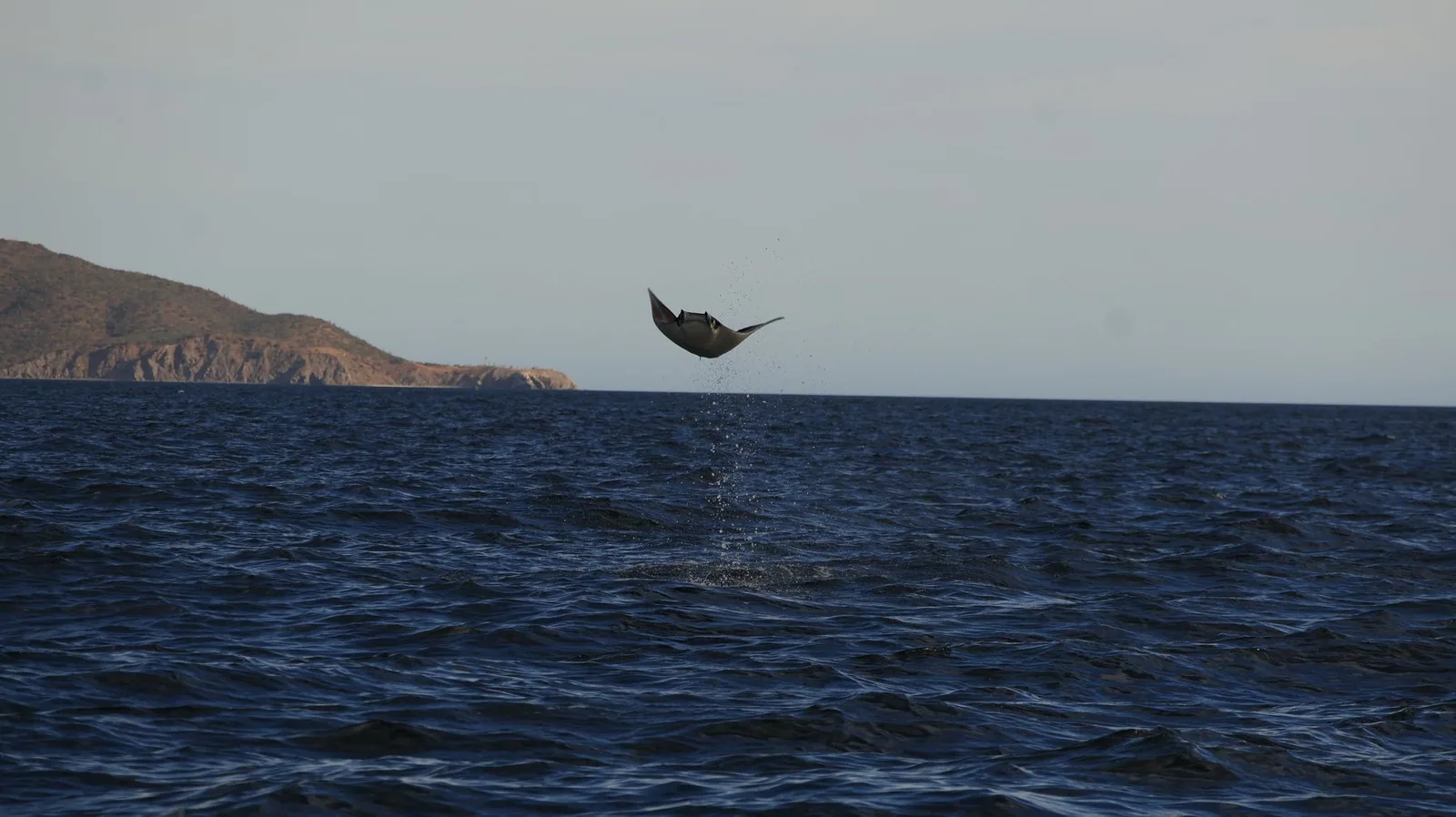
The Munk’s devil ray (Mobula munkiana) is the smallest of the devil rays, a group related to manta rays that swim by flapping a pair of wing-like pectoral fins. Unlike giant mantas, it typically travels in large groups and is the species most commonly seen in the Sea of Cortez off Baja California Sur.
It is listed as Vulnerable on the IUCN Red List, meaning its population faces enough pressure to concern scientists, though not yet at the highest risk level.
Aggregations of thousands of individuals
Since at least 2013, local fishers and tour operators in the region had known of a well-established aggregation of this species at Ensenada Grande, in the Espíritu Santo Island archipelago off La Ventana. A study published in 2021 in Scientific Reports described that bay as a nursery area for the first time: 84% of tagged individuals were newborns or juveniles, and some stayed in the bay for as long as 145 consecutive days.
The same research identified a pupping period between April and June, based on pregnant females and mating behavior observed during that window.
La Ventana, a key site for their reproduction
A second study, published in 2023 in the journal Marine Biology, analyzed 221 reproductive events among three devil ray species in the southern Gulf of California. Of those, 209 occurred in La Ventana and the nearby Ensenada de Muertos, leading the authors to describe both sites as critical reproductive habitat for these species.
Courtship activity concentrated between March and August, peaking in May: nearly 82% of recorded events happened that month. In one documented episode, 122 mobulas formed a vortex, circling in the same direction for roughly five hours.
Why do they leap out of the water?
The same 2023 study documented a courtship behavior it called a piggyback leap: a male mounts a female’s back during the chase that precedes mating. That is a different behavior from the full aerial leap often seen in schools, which is far more frequently photographed.
Regarding that more familiar aerial leap, a researcher with the Gulf of California Marine Program has suggested it might work as a signal to draw other mobulas toward the aggregation. It is a reasonable idea, but so far no study has tested it: it is worth presenting as a hypothesis, not a proven fact.
What this means for a trip to La Ventana
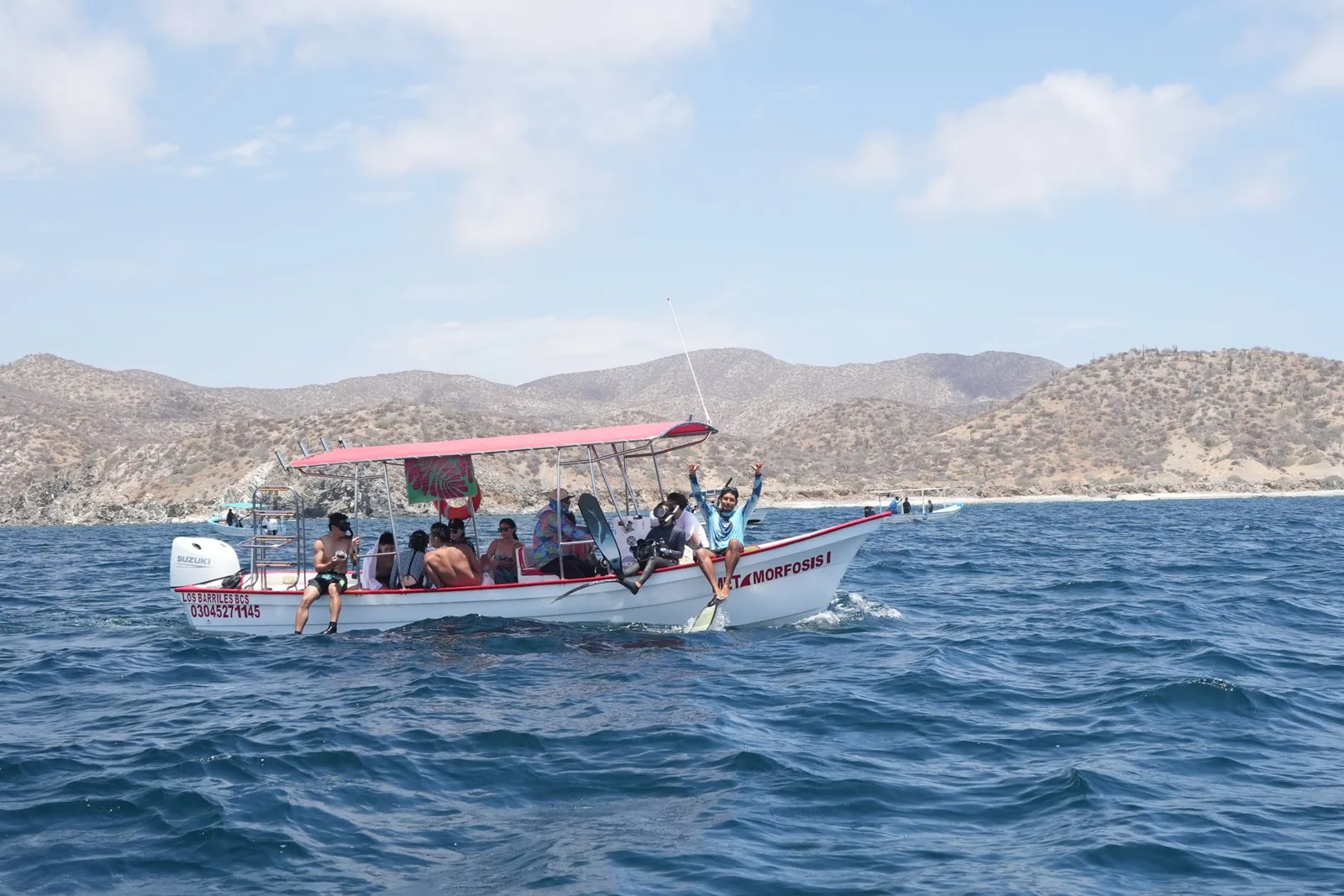
Con Gorra’s La Ventana expedition takes place within this same aggregation and breeding region. No operator can guarantee a school of a thousand mobulas: their presence depends on the season, sea conditions, and the free behavior of an animal classified as vulnerable.
Watching them with respect — without chasing or touching them, letting them set the distance — is not just courtesy: it is part of what allows a population under pressure to keep gathering here year after year.
References to keep exploring
- Scientific Reports · Palacios et al. (2021) · Description of first nursery area for a pygmy devil ray species (Mobula munkiana) in the Gulf of California, Mexico
- Marine Biology · Palacios et al. (2023) · Reproductive behavior, seasonality, and distribution of three devil ray species in the Southern Gulf of California, Mexico
Sources accessed on November 8, 2026. Editorial text by Con Gorra Expeditions.