Marine life
Gray whale mothers and calves: why Baja’s lagoons matter so much
A mother’s body condition determines whether her calf survives the trip back to the Arctic. Here is how drones help track one of the most vulnerable stages of the migration.
A journey that starts with a newborn calf
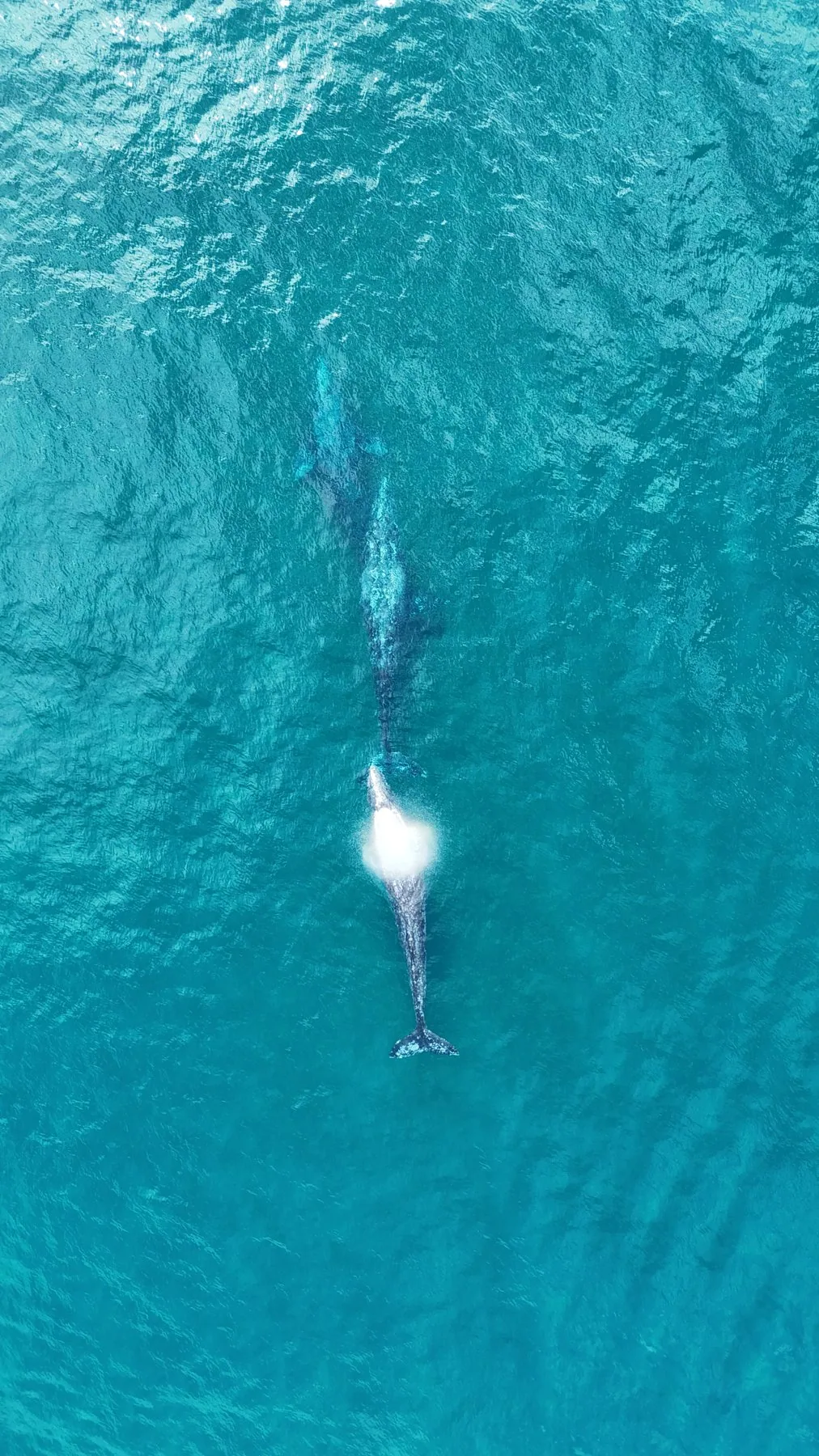
Female gray whales arrive at the lagoons of Baja California Sur to give birth and nurse, sheltered from two of the biggest risks to a newborn calf: open ocean swell and orca attacks. Once mother and calf are ready, they head back together toward the Arctic feeding grounds, a journey of thousands of kilometers.
How a mother’s health is tracked
Since 2015, NOAA’s Southwest Fisheries Science Center has used small drones to photograph mother-calf pairs during their northbound migration along the central California coast. From those photos, they measure each whale’s length, width and body surface area, calibrating the measurements against drone altitude and camera specs, down to a margin of just a few centimeters.
The width-to-length ratio works as a health indicator: a whale that is relatively "wider" for its length likely fed well the previous summer in the Arctic.
Why the previous year’s feeding matters so much
For much of their migration, gray whales feed only opportunistically: they rely heavily on fat reserves built up in the Arctic to fuel the journey, birth and nursing. If a feeding season was poor, that can translate — sometimes with a lag of several years — into fewer calves born, or fewer calves surviving the migration.
A recent warning sign
Since 2019, the eastern Pacific gray whale population has been going through what NOAA classifies as an Unusual Mortality Event. Calf counts have been low ever since: the most recent estimate, from 2025, was 85 calves, the lowest figure in NOAA’s data series, which goes back to 1994. This is not a definitive collapse, but it is a trend worth following closely, without jumping to alarm.
What this means for an expedition in López Mateos
Mexico’s whale-watching standard prohibits coming between a mother and her calf, precisely because those first months are so decisive. Seeing a mother and calf in López Mateos is not just a memorable encounter: it is witnessing a fragile stage of a story that began in the Arctic the summer before, with thousands of kilometers still to go.
References to keep exploring
Sources accessed on November 8, 2026. Editorial text by Con Gorra Expeditions.